A quiet afternoon, a familiar scene and the pleasure of finding one tiny detail can be a lovely invitation to slow down together. For older adults who enjoy puzzles, an activity book offers an easy way to spend time with something interesting, creative and comfortably screen free.
A Gentle Invitation to Pay Attention
Hidden-object puzzles ask us to look closely, compare shapes and search for details. A ribbon tucked beside a chair or a little bell among Christmas decorations gives the page a clear, manageable purpose. There is something satisfying about spotting what you have been looking for.
Let the person choose the pace. One page may be plenty; on another day, finding just two or three objects may be enjoyable. Leave the timer off and allow time to look, pause and return later.
Familiar Pictures Can Open a Conversation
A rocking horse, a snowy shop window or an old-fashioned Christmas tree can offer a starting point for a story. You might ask, “Did your family have decorations like these?” or “What did Christmas morning look like when you were young?”
Follow the conversation wherever it goes. A memory about a favourite toy may matter far more than finding the next object. For someone living with dementia, gentle invitations to share can feel more comfortable than questions that test recall. Simply describing what you notice is another way to begin.
Small Discoveries Can Feel Rewarding
An activity works best when it feels achievable and worth doing. Offer a choice of pages and ask whether a hint would be welcome. Give the person time to make their own discoveries and enjoy the moment with them.
A quiet “You found it!” may be all the encouragement needed. If the page becomes frustrating, switch to looking at the pictures, talking or another activity the person prefers.
Choose Comfort and Enjoyment First
Age alone does not tell you what someone will enjoy or find easy. Some readers love intricate scenes; others prefer fewer details and clearer pictures. Match the book to the person’s interests, vision and energy on the day.
- Look for readable print and clear pictures. Check a sample page if possible; large lettering does not necessarily mean the puzzle itself is easy to see.
- Set up a comfortable space with good lighting and minimal glare. Keep glasses or a magnifier nearby if the person uses them.
- Begin with a short session, perhaps 10 minutes, and continue only while it feels enjoyable. There is no daily target to meet.
- Offer different ways to participate. Pointing, describing an object or asking a companion to mark it can work as well as holding a pencil.
- Make room for company. Take turns, work as a team or invite a grandchild to join. Ask before giving clues or taking over.
- Leave space for other pleasures. Music, crafts, conversation and suitable physical activity can all have a place in a varied day.
Keep the Health Claims in Perspective
Puzzles can provide an enjoyable mental challenge, but a commercial activity book should not be presented as a proven way to prevent dementia or restore memory. The National Institute on Aging notes that evidence for lasting cognitive benefits from many mentally engaging leisure activities remains uncertain.
Likewise, marking a page is an opportunity to use the hands, rather than a promise of improved dexterity or independence. The clearest reason to choose a book is that the person enjoys it: a pleasant activity, a shared laugh or a conversation they want to continue.
Further Reading
- National Institute on Aging — Cognitive Health and Older Adults
- Alzheimer’s Society — Activity Ideas for People With Dementia
Bring a Little Christmas Nostalgia to the Table
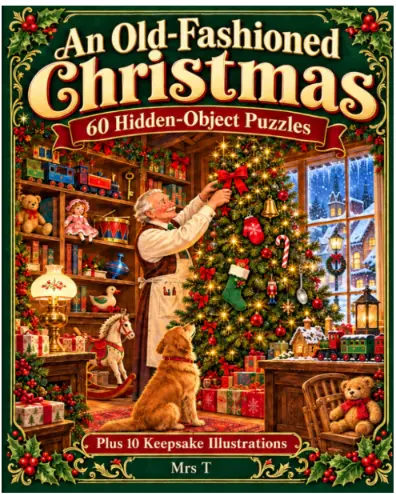
If old-fashioned Christmas scenes appeal to you or someone you love, consider An Old-Fashioned Christmas by Mrs T. With 60 hidden-object puzzles plus 10 keepsake illustrations, it offers a festive theme for quiet afternoons and time spent together.
Before choosing it for a relative or care setting, check that the print size and picture detail suit the reader. Then settle into a comfortable spot, open a page and see where the pictures take you. Perhaps you will find a hidden object. Perhaps you will hear a story you have never heard before.